Book Review: Manuscript Found In Accra by Paulo Coelho

I just finished “The Alchemist” by this same author literally about two months ago and his writing was so good that I had to go and read some more. With that said, today I’m going to be reviewing “Manuscript Found In Accra” which is the second book that I have read from Mr. Coelho.

The structure of the novel was different from most I have read in that its chapters are formatted as answers to questions that are posed to the main narrator of the book, known as “The Copt”. The backstory to the book is that what you are reading is the manuscript that the citizens of Accra compiled in the hours before they were overrun by their enemies who are waiting outside of Accra’s city gates for nightfall to attack. The citizens have little means of defending themselves from the inevitable, and so at the advice of the mysterious and wise figure of the city, “The Copt”, the citizens gather together to record not the last hours of their beloved city and the battle to come that will erase it all, but what history will truly wish to know about their civilization — their daily lives. And thus, one by one, the citizens offer the Copt their questions that he answers with the beauty and significance of answers that will never be given again and yet will eternally hold true.

The chapter that was most poignant to me was when “a man who always woke up early to take his flocks to the pastures around the city said: ‘You have studied in order to be able to speak these beautiful words, but we have to work to support our families.'” to which the Copt’s response is the articulation of an instinctive truth within me that has been skillfully put to language in Coelho’s book. Much of Coelho’s writing is like that: the transcription of a soul’s truths. It transcends all cultural, generational, religious, racial characteristics and speaks directly to the source that springs from everyone one of us. It is deeply personal, yet impersonal because it is my source, but it is also in all of you.

Although this is only my second book from Mr. Coelho, I get the feeling that his books can’t be read just once, they need to be revisited again in between the different phases of your life. When you think that you’ve forgotten the lessons in the book, you’ll have to pick it up and read it again with fresh, new eyes colored by your new experiences.

signature

Book Review: Why “A” Students Work for “C” Students

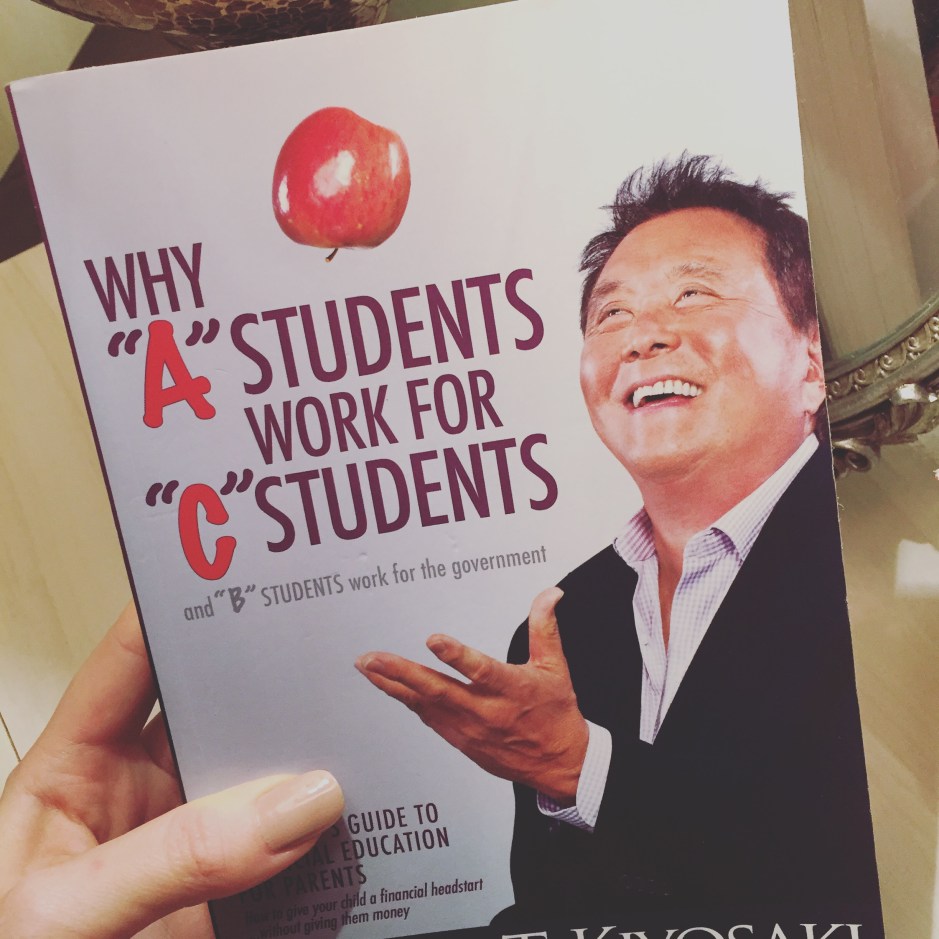
Why “A” Students Work for “C” StudentsYou’ve probably heard of Robert Kiyosaki, if you haven’t you’ve probably heard of him you’ve most likely heard of his best-selling book, “Rich Dad, Poor Dad” . He has written numerous books on this subject or similar ones and this book that I’m reviewing today is presented as different lessons that parents can teach their young children to impart on them financial knowledge that isn’t taught in schools.

Kiyosaki starts the book off with the problem of money management not being taught in school and students being taught instead to “go to school to get a job” and that “if you don’t go to school, you won’t get a job”. It is because of this issue with our current educational system that Kiyosaki offers this book as a way for parents to raise their children with financial know-how. The rest of the book goes on to distinguish between the 4 types of ways people earn income, by either being an employee, a small business owner, entrepreneurs of large businesses, or a professional investor and the different advantages and disadvantages each type brings with it. Since Kiyosaki believes that being an entrepreneur or an investor is the best option, he goes on to explain different lessons that a parent can teach their child to start seeing the world through the eyes of a true capitalist, a true entrepreneur, instead of an employee as much of their schooling would train them. Kiyosaki touches on many different hot topics in the book, but one that resonated with me was what he had to say about one topic that I believe is crucial to our nation right now, “The Entitlement Mentality”. He and I both share the concern that the entitlement mentality is spreading in our nation and we both understand how for someone who has run in hardship and has no financial education, this can be a way of life, but I think Margaret Thatcher put it succinctly when she said, “the problem with socialism is that you eventually run out of other people’s money”.

I know that Kiyosaki has been the subject of controversy before due to his anecdotal style of writing on subjects that require very specialized knowledge to successfully apply in one’s life, but I don’t believe he means for his books to be read as a manual. There are literally hundreds of thousands of books that layout the step-by-step method for achieving your financial goals in whatever method you choose, but I see his writing as a call toward a greater paradigm shift in our nation’s thinking about money, not as some sort of how-to book on accumulating wealth. Honestly, if his books were that technical, I don’t believe they would be nearly as successful as they are now. If someone who reads his books becomes inspired to take action in their financial life, then there are plenty of authors that offer that sort of knowledge, but to accuse Kiyosaki of peddling substance less stories is unfair.

Clearly, my bias is showing, so obviously, I recommend you read this book and his other books. I know that the concepts he discusses in his books have changed my life and I plan to use this book to have my children be brought up to be financially saavy. It is rare to find a financial book geared towards children, which makes it that much more important to read this one!
signature

Book Haul: Ghosts, Finance, and the Art of War

I stopped by my neighborhood secondhand book shop to see if I could find something interesting to read. All of the books I have right now have already been read or I was just not in the mood for. At first it took me a while to find anything of interest, but I kept browsing mainly as an excuse to stay warm from the wind and the rain outside. Unexpectedly, I came across a tattered, bright blue book in the clearance section of the collectibles. The title on the front had long been worn off, but I could still make out “Haunted Homes and Family Legends” in the top left hand corner. The spine gleamed with those same word in gold lettering. The publication date on the first page of the book read April 3, 1911. That pretty much sealed the deal for me. A beautiful book dating from the early 20th century full of scary stories and it’s only $10? I’ll take it.

image3 [88581]

After that, I found a couple of finance books that I had been looking to read, “Why ‘A’ Students Work for ‘C’ Students” by Robert T. Kiyosaki and “The Millionaire Mind” by Thomas J. Stanley. In the same finance section I discovered an interesting take on Sun Tzu’s “Art of War” — “The Art of War for Women” by Chin-Ning Chu.

image1 [88579]

I can’t wait to dive into these reads and share my thoughts with you.

signature

Desert Queen, by Janet Wallach

This book holds the balance between an informational, historical, romantic, and suspenseful story so effortlessly that you forget that it is a biography. Now, I rarely read biographies — I can’t even remember the last time I read one — but if they read anything like this one, I need to start making it a more common occurrence. The book chronicles the life of Miss Gertrude Bell, a fiercely intelligent and unabashedly gutsy Englishwoman who “explored, mapped, and excavated the world of the Arabs.” She lived in tents, crossed the desert on camel back with Bedouins, negotiated talks between dangerous warlords, got captured as a prisoner in the process, but also left time to update her wardrobe with the latest fashions from Europe. She basically drew the borders for Iraq and Jordan and helped nurture the governmental foundations of those two countries in the 1920s. The National Museum of Iraq, known in her time as the Baghdad Archaeological Museum, was formed due to her love of archaeology and passion for Iraqi culture and history. It houses artifacts of one of the earliest known civilizations in the world — the Mesopotamian culture and Babylonian Empire — and while the museum was looted during the 2003 invasion of Iraq, it reopened this year after much refurbishment.

I chose to highlight just a couple out of her many and impressive achievements, but I think they give you a taste for the adventure, passion and influence Bell brought into the world. The story is so skillfully written, that it’s hard to believe that Wallach so seamlessly connected Bell’s life by little more than her letters and diary entries. Of course, as a voracious writer who was acutely aware that her words were recording history as it happened, Bell had left behind thousands of pages of material, but nevertheless, it was no simple undertaking for Wallach to flawlessly meld such a rich and tangled history into this unified book. I highly recommend you to read about this marvelous lady who is now my personal icon. I share so much in common with her: our love of languages, history, Sumerian archaeology, fashion, and we even have the same birthday! *Sigh* Of course, I have yet to create the political framework of a country or head a national library — but there’s still time while I’m alive!

signature

Book Review: French Women Don’t Get Fat

I am sure many of you have heard of a very popular health and cooking book called, “French Women Don’t  Get  Fat”. It was an enormous commercial success amidst a transition in the diet and health industry towards favoring a holistic,  pleasurable, “slow food” approach to long-term health and weight loss, in stark contrast to the obsessive calorie-counting, restrictive, puritanical tone to achieving your ideal body that had dominated the weight loss industry. If you have not yet read the book, I highly suggest you do so.  It will shift your attitude towards your ideal body, the traditions and ritual of food preparation and enjoyment with the larger goal of discovering and cultivating your little pleasures.

{6B7D5384-DC09-421E-87A6-7609971F5B81}Img100

Giuliano writes this diet book within the context of her own weight loss story after some late adolescent weight gain after a study abroad trip to the states. The experience of reading this diet book is so different from any other you may read because it is a story that Giuliano tells so charmingly well. It is an incredibly liberating and enjoyable experience to see the subject of food and weight loss presented in such a way that puts back the ritualistic and sensory pleasures of dining. There is no mention of calories, counting, fat, carbs, gym memberships. and the endless other unpleasantness that are found in any other weight loss book. Just sensible portions, fresh and seasonal ingredients, some light walking and other slow and easy shifts in your habits is what this book is about. A distinctly French method that emphasizes pleasure over deprivation and shuns the “no pain, no gain” approach to living in and loving your ideal body.

Although the concepts are simple enough to remember and apply in my daily life, and while I may not eat certain staples of the conventional French diet such as wine, cheese, or bread, I still find myself reaching for this book every once in a while just to enjoy Guiliano’s storytelling. I find that this book is more than just about weight loss; it’s about getting to know yourself and cultivating your own pleasures in not just food, but also in life. I think that we all work very hard to create the lives we want to live and between the demands of schooling, work, and family, this book has helped me to learn how to take my moments to take care of myself and perhaps its can bring about that same shift for you. 

signature