Book Review: “I Dare You” by William H. Danforth

It is a rare and beautiful thing to read a book and know that your life will never be the same after having read it. Your mind becomes alert to new truths that you’ve always known but now have seen them articulated in writing and understood.

You can never forget this book. You will either apply its instructions and see your life change in unimaginable ways or you will not and live with the regret to know that if you had summed up the courage and energy, your life could be very different.

This is really powerful stuff, if properly wielded.

image1

I found this book in a thrift store for $3.99. It was a hardcover book, a little dirty, in the business section. I know you’re not supposed to judge a book by its cover, but it said, “I Dare You!”, and I just can’t back away from a dare. And I’m eternally grateful that I dared. It’s a short read; I finished it in a day since it dared me to (ha!) but this is a book that I’ll need to keep by my bedside and refer to until I’ve internalized its lessons.

I don’t know if this is a popular book. I haven’t heard it talked or written about, so I’m going to guess that it isn’t. But that makes its teachings all the more valid to me. I’m so fed up with those feel-good self-help books that make it seem like all you need is “positive thinking” and “visualization” to “manifest” the life of your dreams. I know that those techniques can help, but there is a heck of a lot of old-fashioned hard work and hustle that goes into living the life you want as well, which is conveniently omitted from these books. I guess it makes sense to leave that important part out — you probably won’t sell as many books if you tell it like it really is because who wants to hear that you need to continually learn, demolish your comfort zones, be stronger, faster and smarter than the average person to live an extraordinary life? No one. At least no one who isn’t serious about making some really big shifts in their life.

This is where this book differs. It gives you the concrete four-fold development program (physical, mental, social and spiritual) that will need to be applied each and everyday to be one of the 4% or 1% who actually go on to succeed with their “magnificent obsession”. You won’t know what I’m talking about unless you read this book and I’m not going to be able to better articulate it than Mr. Danforth. This book is for you if you want a method for getting the most out of life and you want a real, solid plan in place to accomplish that. Granted, some of the information in the book is dated (it was published in 1978) but the program allows for personalization so that it can be adapted for any era. So read it — I Dare You!!


signature

On Learning Languages

I have a lot of trouble seeing things through with the exception of about 3 things: my work, reading, and learning languages. So while my interests may come and go, ever since I was around 11 years old when I first started learning French in middle school, acquiring languages has been a relatively long-standing interest of mine. As such, I have collected a lot of methods for keeping that interest alive (even through the grammar bits!) that I would like to share with you today.

     1. Listen to music and memorize the lyrics to some of your favorite songs in the language you are learning.

I’ve found that this helps me learn and mimic the pronunciation and cadence of a language without sounding like a machine as most of those language learning programs do. Plus, you will be able to memorize the vocabulary much easily when its in a song.

2. Listen to language learning podcasts, watch youtube videos and movies with subtitles in the language.

I work and have many obligations outside of work that don’t provide me with much free time to sit and memorize vocabulary and grammar from a book (not that I’d want to even if I did) so I make language learning as enjoyable and interesting as possible. Granted, at the beginning stages of learning a language, you will need a book to learn from, however if you’re past that stage and have a grasp of the grammar and some vocabulary under your belt, start listening to the language in contexts that interest you. This makes the whole process much easier and fun, plus it’s cool see how much of the youtube comments you can understand!

3. Purchase and read from a dual language book.

These are great for visual learners. They are complete books or short stories with the foreign language on one side of the page and the English translation on the other side of the page. You are basically reading the book in the foreign language but have the English translation to help you out if you get stuck. This makes it easier to enjoy engaging in the language without having to search for the definitions!

4. Start to journal in the language.

I keep a (almost) daily journal and I alternate between different languages throughout the days of the week. This is great because you can start to acquire the vocabulary that allows you to express yourself in the language without feeling embarrassed if you make a mistake. You can start very basic (Today, I was happy.) and eventually through continued learning you’ll find yourself being able to write a pretty respectable journal entry.

5. Stay exposed to the language everyday — even if its for a few minutes.

Trying to keep all that goes into acquiring a new language in your head can be a tricky endeavor, especially when you don’t have anyone to speak with or are residing in your native country. It is crucial for me to spend some time everyday interacting with the language I am either learning or retaining.

So there are my 5 tips for learning and retaining languages. If any of you are learning a language or keeping up with one, please do let me know what works for you. I’m always interested to find new ways to interact with foreign languages!

signature


Book Review: Manuscript Found In Accra by Paulo Coelho

I just finished “The Alchemist” by this same author literally about two months ago and his writing was so good that I had to go and read some more. With that said, today I’m going to be reviewing “Manuscript Found In Accra” which is the second book that I have read from Mr. Coelho.

The structure of the novel was different from most I have read in that its chapters are formatted as answers to questions that are posed to the main narrator of the book, known as “The Copt”. The backstory to the book is that what you are reading is the manuscript that the citizens of Accra compiled in the hours before they were overrun by their enemies who are waiting outside of Accra’s city gates for nightfall to attack. The citizens have little means of defending themselves from the inevitable, and so at the advice of the mysterious and wise figure of the city, “The Copt”, the citizens gather together to record not the last hours of their beloved city and the battle to come that will erase it all, but what history will truly wish to know about their civilization — their daily lives. And thus, one by one, the citizens offer the Copt their questions that he answers with the beauty and significance of answers that will never be given again and yet will eternally hold true.

The chapter that was most poignant to me was when “a man who always woke up early to take his flocks to the pastures around the city said: ‘You have studied in order to be able to speak these beautiful words, but we have to work to support our families.'” to which the Copt’s response is the articulation of an instinctive truth within me that has been skillfully put to language in Coelho’s book. Much of Coelho’s writing is like that: the transcription of a soul’s truths. It transcends all cultural, generational, religious, racial characteristics and speaks directly to the source that springs from everyone one of us. It is deeply personal, yet impersonal because it is my source, but it is also in all of you.

Although this is only my second book from Mr. Coelho, I get the feeling that his books can’t be read just once, they need to be revisited again in between the different phases of your life. When you think that you’ve forgotten the lessons in the book, you’ll have to pick it up and read it again with fresh, new eyes colored by your new experiences.

signature

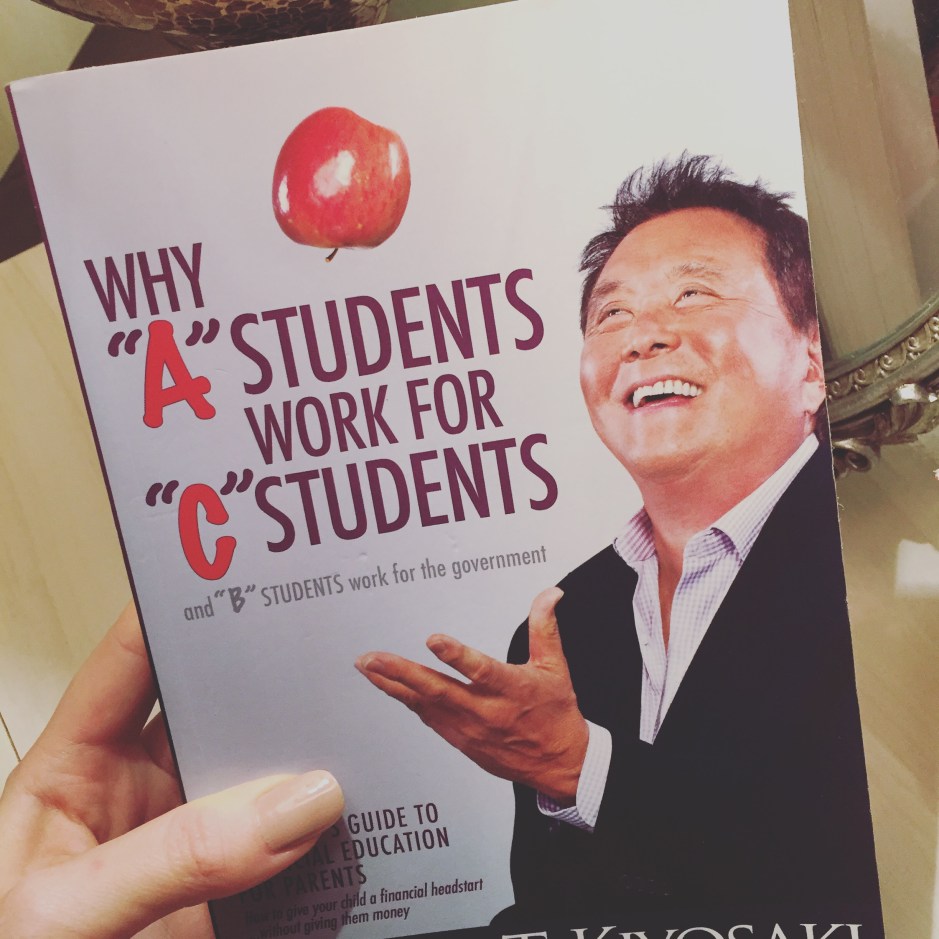
Book Review: Why “A” Students Work for “C” Students

Why “A” Students Work for “C” StudentsYou’ve probably heard of Robert Kiyosaki, if you haven’t you’ve probably heard of him you’ve most likely heard of his best-selling book, “Rich Dad, Poor Dad” . He has written numerous books on this subject or similar ones and this book that I’m reviewing today is presented as different lessons that parents can teach their young children to impart on them financial knowledge that isn’t taught in schools.

Kiyosaki starts the book off with the problem of money management not being taught in school and students being taught instead to “go to school to get a job” and that “if you don’t go to school, you won’t get a job”. It is because of this issue with our current educational system that Kiyosaki offers this book as a way for parents to raise their children with financial know-how. The rest of the book goes on to distinguish between the 4 types of ways people earn income, by either being an employee, a small business owner, entrepreneurs of large businesses, or a professional investor and the different advantages and disadvantages each type brings with it. Since Kiyosaki believes that being an entrepreneur or an investor is the best option, he goes on to explain different lessons that a parent can teach their child to start seeing the world through the eyes of a true capitalist, a true entrepreneur, instead of an employee as much of their schooling would train them. Kiyosaki touches on many different hot topics in the book, but one that resonated with me was what he had to say about one topic that I believe is crucial to our nation right now, “The Entitlement Mentality”. He and I both share the concern that the entitlement mentality is spreading in our nation and we both understand how for someone who has run in hardship and has no financial education, this can be a way of life, but I think Margaret Thatcher put it succinctly when she said, “the problem with socialism is that you eventually run out of other people’s money”.

I know that Kiyosaki has been the subject of controversy before due to his anecdotal style of writing on subjects that require very specialized knowledge to successfully apply in one’s life, but I don’t believe he means for his books to be read as a manual. There are literally hundreds of thousands of books that layout the step-by-step method for achieving your financial goals in whatever method you choose, but I see his writing as a call toward a greater paradigm shift in our nation’s thinking about money, not as some sort of how-to book on accumulating wealth. Honestly, if his books were that technical, I don’t believe they would be nearly as successful as they are now. If someone who reads his books becomes inspired to take action in their financial life, then there are plenty of authors that offer that sort of knowledge, but to accuse Kiyosaki of peddling substance less stories is unfair.

Clearly, my bias is showing, so obviously, I recommend you read this book and his other books. I know that the concepts he discusses in his books have changed my life and I plan to use this book to have my children be brought up to be financially saavy. It is rare to find a financial book geared towards children, which makes it that much more important to read this one!
signature

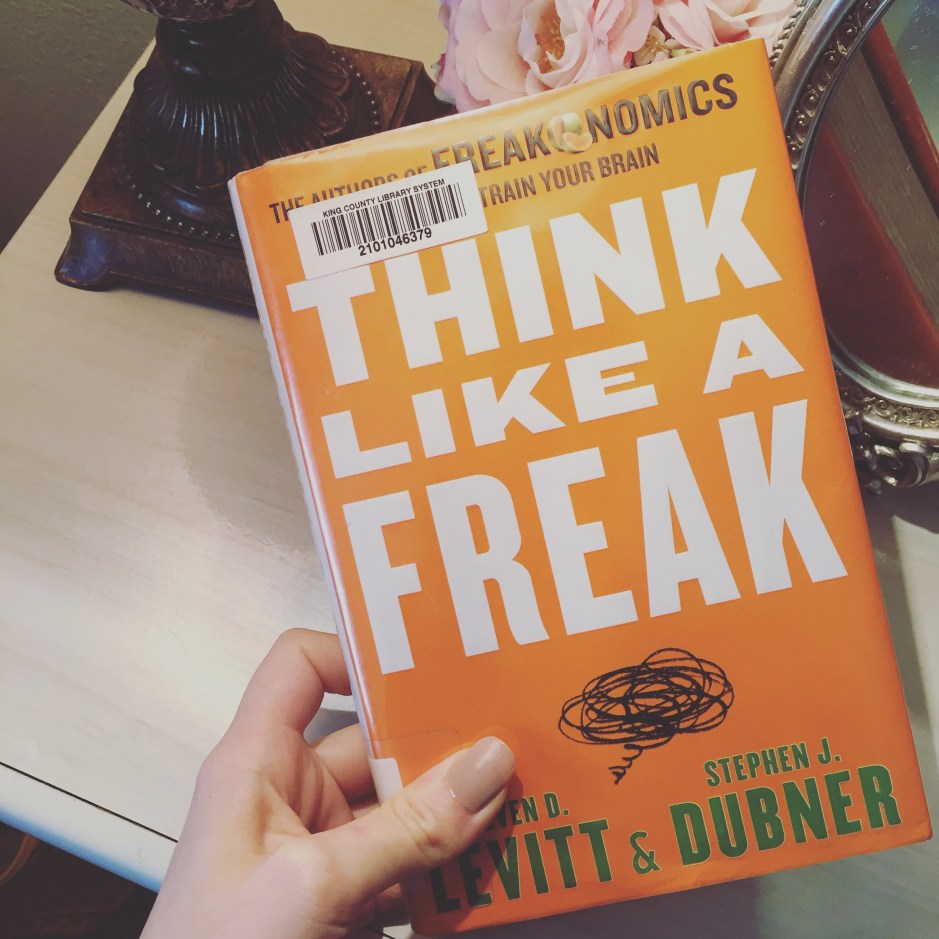
Book Review: Think Like A Freak

The title is a bit misleading. Yeah, that’s what crossed my mind at first too but it’s not what you think it’s about!
This is the actually the third book in a series of books by Steven Levitt and Stephen Dubner, starting with “Freakonomics” and then “Superfreakonomics”. I have not read the first two and I’d never heard of the authors, but I saw this in the library and it intrigued me.

I am always interested in books that delve into understanding the motives and incentives that people are guided by and this book does just that. It explores new ways of thinking to solve problems both global and personal through stories and examples in the realms of business, sports, religion, and many more. Their examples demonstrate how “incentives rule our world” and they actually layout  a simple list of six rules that create an effective incentive scheme for any circumstance. It also goes into the art of persuasion (another one of my favorite topics) and the pointers they give on this subject are ones that I have heard before, but still, they explain abstract ideas and facts that are difficult to believe in an easy and straightforward manner. Another interesting subject that the book concludes with is concerning “failing fast and failing cheap”. We all have heard some sort of version of the virtues of never giving up (in fact just a couple of days ago I tweeted a quote about this) but the authors explore the issue with this sort of aversion for quitting and the opportunity cost of such an unyielding attitude. This subject along with the topic about incentives were the two greatest takeaways for me. I have already made plans on how to use their six step process for incentivizing in both my personal life and my work life, since being a wife and being in management both involve getting people to do things that they really don’t!

Overall, I really enjoyed this book. I’m always on the lookout for fresh, novel methods for approaching my thinking and this book really brought some new ideas to the table that I had never heard before. If you are like me in that regard, I think you would come away with some new food for thought as well and I highly recommend this book.

signature